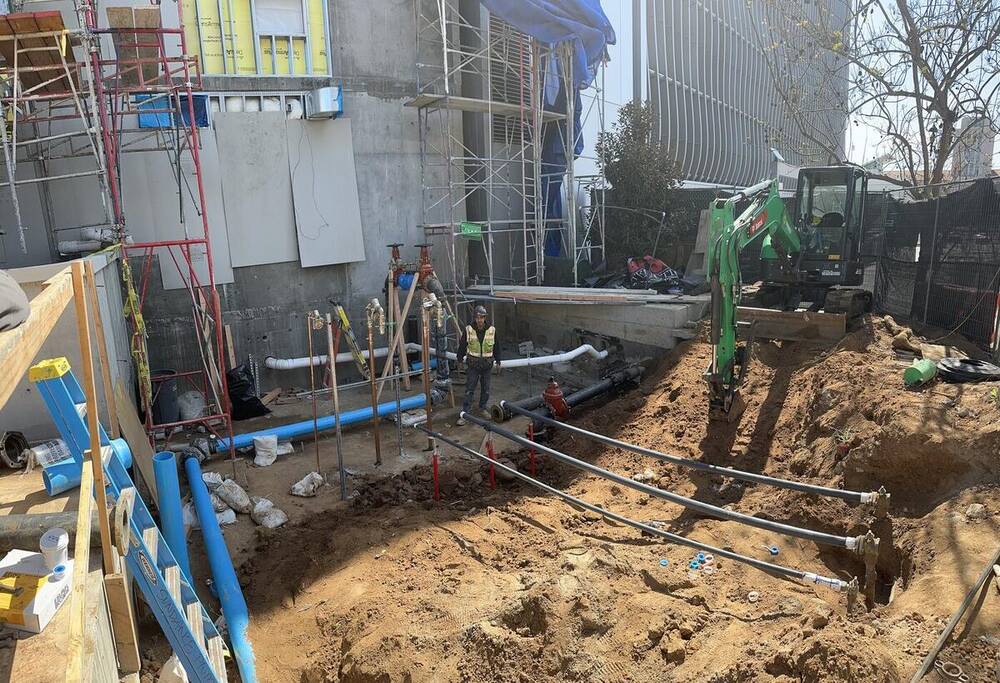
Overview
Fireline work sits in a different category from every other scope we build, because the system we're installing exists entirely for the moment it's needed in an emergency. A private fireline system — the service main, the double check detector assembly (DCDA) or backflow preventer, the post-indicator valve, the connection to the building's fire suppression system — has to work correctly the one time it matters, with no opportunity to discover a problem beforehand except through testing. That's why fire authorities inspect and witness-test fireline installations directly, rather than relying solely on standard agency building-permit inspection.
We install and test private fireline systems and fire service connections to the standards the local fire authority requires, and we build in the plan-check and inspection touchpoints from the start of the schedule rather than treating them as a closeout surprise. A fireline system that isn't coordinated with the fire authority's specific requirements from day one is a fireline system that sits idle waiting on a re-inspection.
What We Install
Private fire service main installation, sized to the fire flow the suppression system design requires
Double check detector assemblies (DCDAs) and reduced-pressure backflow assemblies for fire service protection
Post-indicator valves (PIVs) and fire department connections (FDCs), placed per fire authority access requirements
Private fire hydrant installation and assemblies on commercial and multi-family sites
Tie-ins between the private fire service and the public water main
Testing and inspection coordination directly with the local fire authority ahead of final acceptance
Our Process
01
Fire Authority Plan Check
Fireline plans typically require sign-off from the local fire authority in addition to the building department. We confirm that approval is in hand — or coordinate to get it — before fireline excavation starts, since fire authority requirements can affect pipe routing and appurtenance placement.
02
Excavation & Main Installation
Fire service main is installed to the size and material the design requires, with excavation and bedding handled to the same standard as domestic water main work.
03
Backflow & Detector Assembly Installation
DCDAs and backflow assemblies are set at the height, orientation, and clearance the manufacturer and fire authority both require — these components get inspected closely, and placement errors are one of the most common causes of a failed first inspection.
04
Valve & Connection Installation
PIVs and FDCs are placed for the access and visibility the fire authority requires, coordinated with site civil and landscape plans so nothing ends up blocking access after the site is finished.
05
Hydrostatic Testing
The fire service main is pressure tested per fire authority and NFPA-referenced requirements, typically witnessed rather than self-certified.
06
Fire Authority Final Inspection
Final acceptance requires the fire authority to witness system operation directly — we schedule and staff for that inspection as a defined milestone, not an afterthought once everything else on site is finished.
Materials & Methods
Fire service mains are typically ductile iron or approved PVC per the fire authority's material standards, since fire service specifications are often stricter about approved materials than domestic water specs in the same jurisdiction. Backflow and detector assemblies must be UL-listed and FM-approved for fire service use specifically — a backflow assembly rated for domestic service isn't an acceptable substitute, even if it looks similar on a supply house shelf. We install to the exact assembly model and orientation called out on the approved fire protection plan.
Why Fire Authority Coordination Matters
Every jurisdiction's fire authority has its own inspection sequence, its own preferred assembly manufacturers, and its own scheduling process — and that process runs separately from the general building inspection timeline a GC's superintendent is used to tracking. A fireline scope that isn't sequenced around the fire authority's specific requirements from the start is the single most common way a project's fire/life-safety systems end up holding back a certificate of occupancy at the very end of a job, after every other trade has already finished. We treat fire authority coordination as part of the scope we're bidding, not a separate problem for the GC to solve.
FAQ
Fireline FAQ
What is an underground fireline?
An underground fireline supplies water to a property's fire protection infrastructure. The exact system configuration depends on the project's engineered fire protection plans and applicable requirements.
Does Legend Pipeline install underground fire service lines?
Yes. Legend Pipeline performs underground fireline installation as part of its wet utility construction services.
Can fireline installation include hydrants, valves, and connections?
Depending on the project scope, underground fireline work may include piping, valves, hydrant connections, service connections, and other associated components.
Are underground firelines inspected and tested?
Fireline systems are subject to project-specific testing, inspection, and authority requirements. Installation and testing must comply with the applicable approved plans and requirements.
Can Legend Pipeline install fireline alongside other underground utilities?
Yes. Fireline work can be coordinated with sewer, water, and storm drain installation as part of a larger underground utility scope.
Bidding a Similar Scope?
Have a fireline scope on an upcoming project? Send us the fire protection plan along with the civil and water plans, and we'll bid the full scope — main, backflow, hydrants, and the fire authority coordination that goes with it.
Contact
Let's talk about your next project
Bidding opportunities, plan review, partnerships, or general questions — reach out and we'll respond promptly.
Phone(951) 870-8838
LicenseCA Contractors License CL #1080408
Service AreaLA · OC · RIV · SB · SD
Follow