Overview
Sanitary sewer work is where Legend Pipeline built its reputation, and it's still the scope our crews know best. Mainline sewer installation, lateral connections, manhole construction, and lift station tie-ins all carry the same requirement: get it right the first time. A compacted trench that fails inspection means re-opening a street, re-pouring concrete, and re-scheduling every trade behind us — expensive for everyone on the job. We install sewer systems for general contractors building new developments, municipalities upgrading aging collection systems, and private property owners repairing lines that have failed after decades in the ground.
Every sewer scope starts with the same questions before a single yard of dirt moves: what pipe material and slope does the approved plan call for, what depth of cover and shoring does that require, and where are the utilities already in the ground that our excavation has to protect. Getting those answers right during layout is what keeps a sewer job on schedule instead of turning into a change-order fight three weeks in.
What We Install
Mainline sewer pipe installation in VCP, PVC (SDR 26/35), and ductile iron, to the diameters and slopes called for on approved plans
Sanitary sewer laterals connecting individual parcels and structures to the mainline
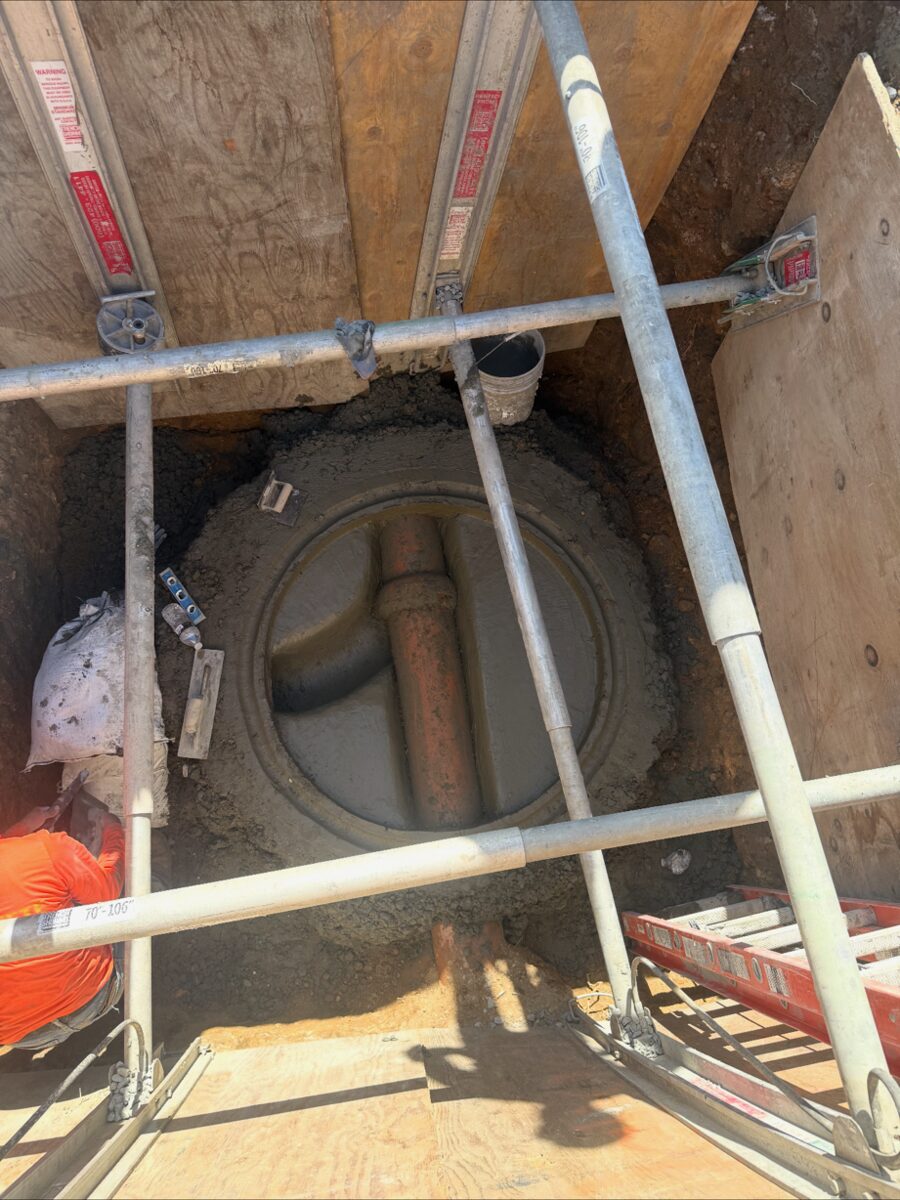
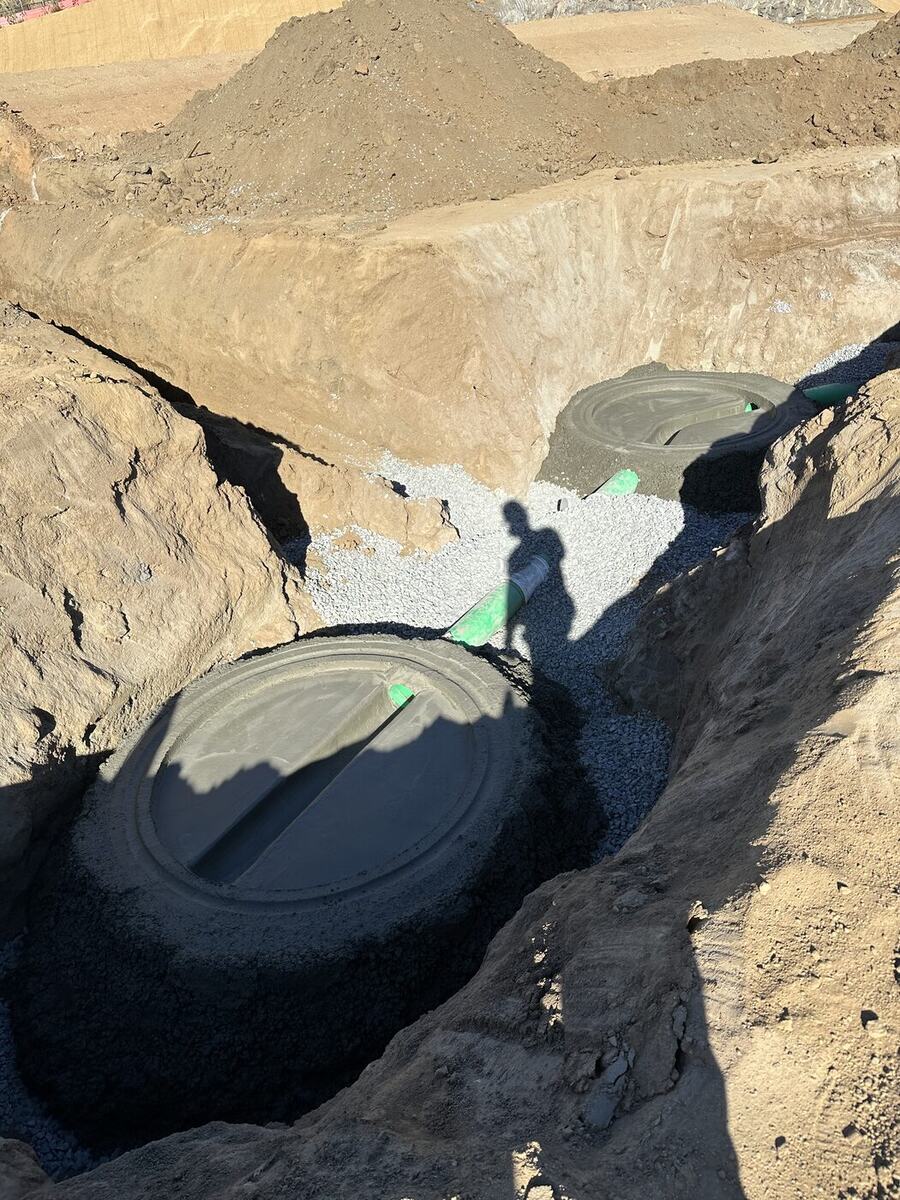
Precast and cast-in-place manholes, including drop manholes on steep-grade runs
Lift station wet wells, force main tie-ins, and pump station coordination
Sewer repair and replacement on existing systems — spot repairs, point repairs, and full-segment replacement
Cleanouts, backwater valves, and other appurtenances required by local agency standards
Our Process
01
Layout & Potholing
Before excavation starts, we pothole to confirm the actual location and depth of existing utilities shown on the plans. A gas line or fiber conduit that isn't where the plan says it is can stop a crew cold, so we find out before the excavator does.
02
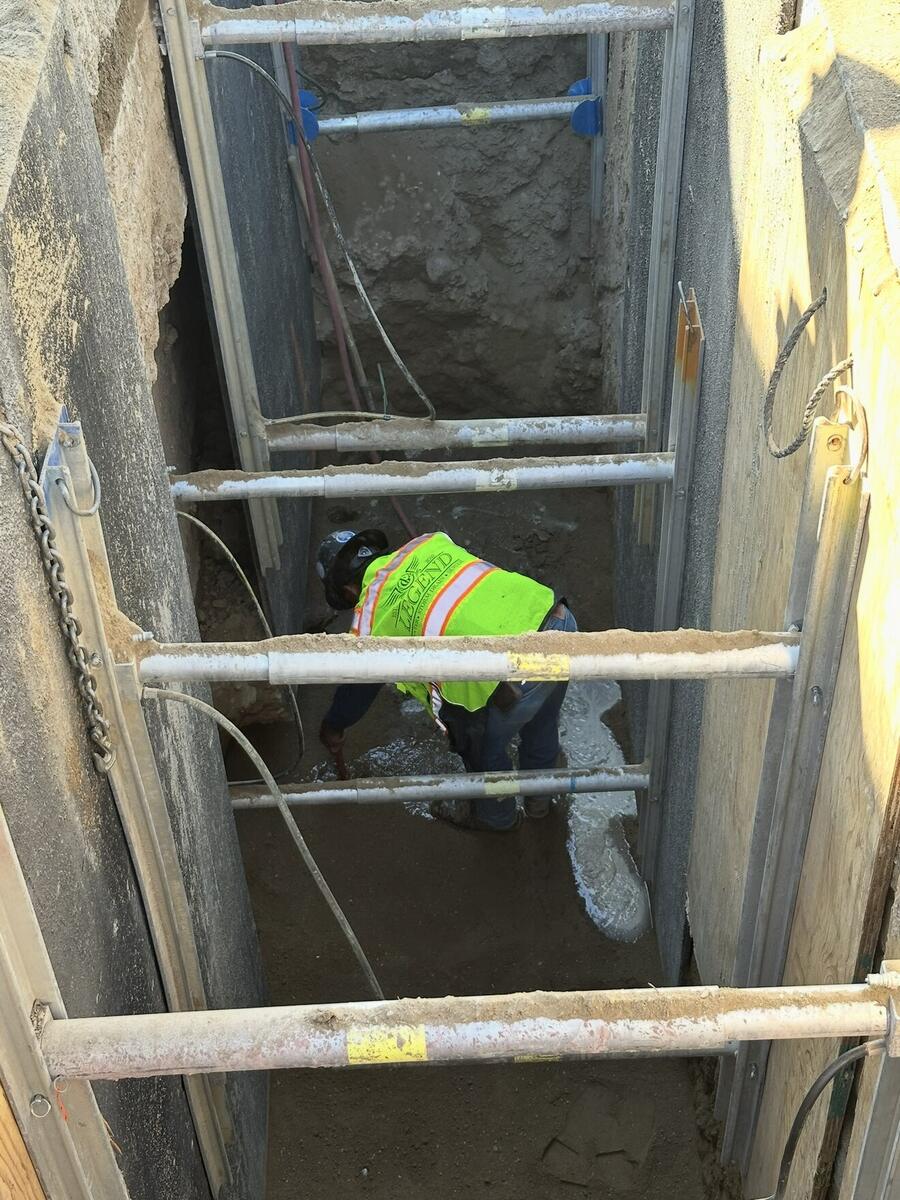
Shoring & Excavation
Sewer trenches routinely run deeper than 5 feet, which means engineered shoring — trench boxes, slide rail, or sheeting depending on soil conditions and depth. We size shoring to the actual trench, not a generic assumption.
03
Bedding & Pipe Placement
Pipe bedding material, lift thickness, and compaction all affect long-term line and grade. We set grade with laser control, because a sewer line that doesn't hold its design slope will hold water — and a line that holds water fails inspection.
04
Backfill & Compaction
Backfill goes in in controlled lifts with compaction testing at the intervals the agency or geotechnical engineer requires, so there's a paper trail proving the trench was built to spec.
05
Testing
Depending on the agency, that means mandrel testing for pipe deflection, air or vacuum testing on gravity lines, and mainline video inspection. We schedule testing early enough that a failed test is a fix, not a crisis.
06
Restoration & Closeout
Trench patch, final paving restoration, and as-built documentation close out the job. We track redline changes in the field as we go, so the as-builts we hand over reflect what actually got built.
Materials & Methods
Southern California agencies specify a mix of pipe materials depending on jurisdiction, and we install to whatever the approved plan calls for. Vitrified clay pipe (VCP) remains standard for some municipal collection systems; PVC (SDR 26 or SDR 35) is common on private and newer public work; ductile iron gets specified where structural loading or depth demands it. Manholes are typically precast concrete with cast-iron frames and covers rated for traffic loading, though cast-in-place structures come into play on custom depths or non-standard configurations.
Public & Private Work
Sewer scopes split into two different rhythms. Public agency work runs on the agency's inspection schedule, submittal process, and standard plans — the contractor's job is to build exactly to spec and document everything, because the agency's inspector has final say before the line goes into service. Private work, for a developer or a commercial pad, usually moves faster and gives us more direct say in sequencing, but it still has to pass whatever agency ultimately takes over maintenance of the line once it's built — most private sewer laterals tie into a public main, and that tie-in point is inspected by the same agency either way. We bid and build both the same way: to the approved plan, with the paperwork to prove it.
FAQ
Sewer FAQ
What types of sewer systems does Legend Pipeline install?
Legend Pipeline performs underground sewer installation for commercial, development, industrial, and infrastructure projects based on project plans and specifications.
Does Legend Pipeline install sewer mains and laterals?
Our sewer scopes can include mainline sewer systems, laterals, connections, manholes, and related underground infrastructure depending on project requirements.
Can you connect new sewer lines to existing systems?
Yes, sewer scopes may include connections and tie-ins to existing infrastructure when required by the project plans and applicable requirements.
What is involved in underground sewer installation?
A typical scope may include excavation, trench preparation, pipe installation, structures and connections, backfill, compaction, testing, and inspection coordination.
Can I submit civil plans for a sewer installation bid?
Yes. Send the available civil plans, specifications, project location, schedule, and bid information for review.
Bidding a Similar Scope?
Bidding a sewer scope — public or private? Send our estimating team the plans and specs and we'll turn around a bid quickly. If the project needs a site walk before we can commit to a number, we'll tell you that too, rather than guess and regret it later.
Contact
Let's talk about your next project
Bidding opportunities, plan review, partnerships, or general questions — reach out and we'll respond promptly.
Phone(951) 870-8838
LicenseCA Contractors License CL #1080408
Service AreaLA · OC · RIV · SB · SD
Follow